








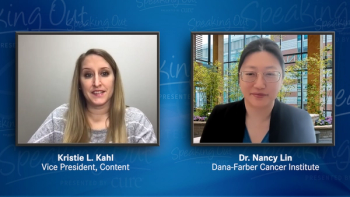
In CURE’s Speaking Out video series, on behalf of Living Beyond Breast Cancer, Dr. Nancy Lin discusses the multidisciplinary approach to metastatic breast cancer care.
In CURE’s Speaking Out video series, on behalf of Living Beyond Breast Cancer, Dr. Nancy Lin discusses the multidisciplinary approach to metastatic breast cancer care.

Treatment with a novel monotherapy in a patient with relapsed/refractory acute myeloid leukemia was effective enough that a successful, as indicated by a significant reduction in bone marrow blasts, stem cell transplant was performed.

Motivating affirmations are one thing, but to me, labels like “survivor” and “cancer-free” are a touchy subject.

From New York Yankees outfielder Aaron Judge giving a brain cancer survivor custom baseball cards to Tom Parker’s brain cancer death and Good Morning America’s Robin Roberts opening up about her cancer experience, here’s what is happening in the cancer space this week.

Watch Saad Z. Usmani, MD, MBA, with Carlyn Rose Tan, MD; Neha S. Korde, MD; and Kenny Capps answer audience Q&A during the CURE Educated Patient Multiple Myeloma Summit.

The FDA plans to decide on whether to approve futibatinib for the treatment of patients with previously treated, locally advanced or metastatic cholangiocarcinoma that harbors a certain genetic mutation by September.

Patients with colorectal cancer that has spread to the liver tend to have poor outcomes and are typically not candidates to receive liver transplants from deceased donors. However, results from a small study on transplanting livers from live-donors could "change this paradigm," an expert said.

Twice a week, my local Gilda’s Club holds a “Lunch and Laughs” group meeting with cancer survivors that has kept me grounded through COVID-19 isolation and beyond.

As a patient moves from treatment to survivorship, the fear of cancer recurrence may overshadow the ability for them to recognize how much they have endured, but support is available to hopefully lessen the burden.

Watch Dr. Carlyn Rose Tan, an assistant attending in myeloma service at Memorial Sloan Kettering Cancer Center, present on risk stratification for newly diagnosed patients.

Tiragolumab plus Tecentriq and chemotherapy did not significantly improve progression-free survival and overall survival in patients with extensive-stage small-cell lung cancer.

Performing genetic testing in every patient diagnosed with colon cancer, and not just those considered high-risk, could identify that person's risk of developing another cancer later in life.

My daughter’s radiation oncologist said that certain treatments may lead to another cancer diagnosis later in her life, but isn’t living better now worth the risk?

It is expected that up to 18 patients with leptomeningeal metastases — a serious form of cancer that has spread from its original location to an area surrounding the brain and spinal cord — will receive treatment with the investigational drug.

Watch Dr. Neha S. Korde, an assistant professor in multiple myeloma service in the Division of Hematology at Memorial Sloan Kettering Cancer Center, present on MGUS/smoldering myeloma.

Approximately 60 patients with metastatic/unresectable solid tumors, including bladder cancer, are expected to be enrolled onto a clinical trial assessing the safety and efficacy of Zepzelca.

Keytruda was well tolerated and demonstrated practice-changing responses with potential for a curative approach in a group of patients with advanced endometrial cancer, according to an expert.

Spring has arrived, and along with it has come fresh challenges and new perspectives regarding my cancer survivorship.

Twenty years of updates in technology, techniques and available medications has provided more hope for patients with colorectal cancer, with more advances on the horizon.

Cancer survivors may often struggle with talking about their fear of recurrence with loved ones, which is why one expert recommends they seek solace in support groups.

The study authors plan to enroll 24 patients with glioblastoma, an aggressive brain tumor, to assess the efficacy an investigational drug plus Libtayo prior to surgery to remove the tumor.

When lovers of “Pinky and the Brain,” “Teenage Mutant Ninja Turtles” and other cartoons gathered in voice actor Rob Paulsen’s hospital room, he took particular notice of one exuberant woman with cancer who was extroverted and kind, despite not having long to live.

Since having both breasts removed in 2014, I’ve been on a hunt for the perfect replacements. Through trial and error, I’ve gone through the good, the bad and the ugly, but finally came across a product that seemed to meet my needs.

A recently FDA-approved drug offers patients with metastatic castration-resistant prostate cancer a newer treatment that improves survival, but is not curative of the disease, which means that more research is needed, according to an expert.

It is essential that patients and providers discuss appropriate options for maintenance therapy after ovarian cancer, one expert explained.

The FDA’s decision follows a recommendation from a panel of experts that suggested the agency not approve sintilimab plus the chemotherapy pemetrexed and platinum-based chemotherapy for patients with non-squamous non-small cell lung cancer.

Today is my birthday, and while I’ve had some unforeseen changes in my cancer treatment lately, I’m grateful to still be here to celebrate.

AstraZeneca, the manufacturer of the drug, announced that treatment with Imfinzi plus chemoradiotherapy did not improve survival compared with standard-of-care chemoradiotherapy alone in patients with locally advanced cervical cancer.

The trial will be testing TARA-002 in patients with non-muscle invasive bladder cancer with high-grade carcinoma in situ and high-grade papillary tumors.

At first, I struggled to keep up with the scientific jargon being presented at a cancer conference, but eventually I hit my stride and now I leave these events with a renewed sense of inspiration.